For Personal Injury & MedMal Managing Partners
Somewhere in your last case file,
there's a page like 412.
The one note that almost gets missed, not from carelessness, but because it's buried across six different logins instead of one connected file. NeXa builds the chronology, cites the research, and traces every answer back to its exact source page, so nothing gets missed on the way to a filing.

" NexLaw reduced our medical record summary turnaround from 3 days to 15 minutes while maintaining 100% citation accuracy — a real difference for how our team prepares cases. "
The six-login problem
One Case, Six Logins, Zero Single Source of Truth
This is what prepping one PI case looks like at most boutique firms right now, not because anyone chose it this way, but because it accumulated one point solution at a time.
The re-entry tax
The same case facts get typed into a chronology tool, a research tool, and a drafting tool. Three separate times, three chances to introduce an error.
No single audit trail
When a citation gets challenged, nobody can point to one system that shows exactly where an answer came from because no one tool holds the whole file.
The verification add-on
Firms end up paying for a separate tool just to check what the other five already produced, verification becomes an extra step instead of a built-in one.
How NeXa replaces the stack
From Case File to Court-Ready. Three Steps, One Login.
Ask
Upload the file or describe the case in plain English, chronology, research question, or deposition transcript.
Research & Build
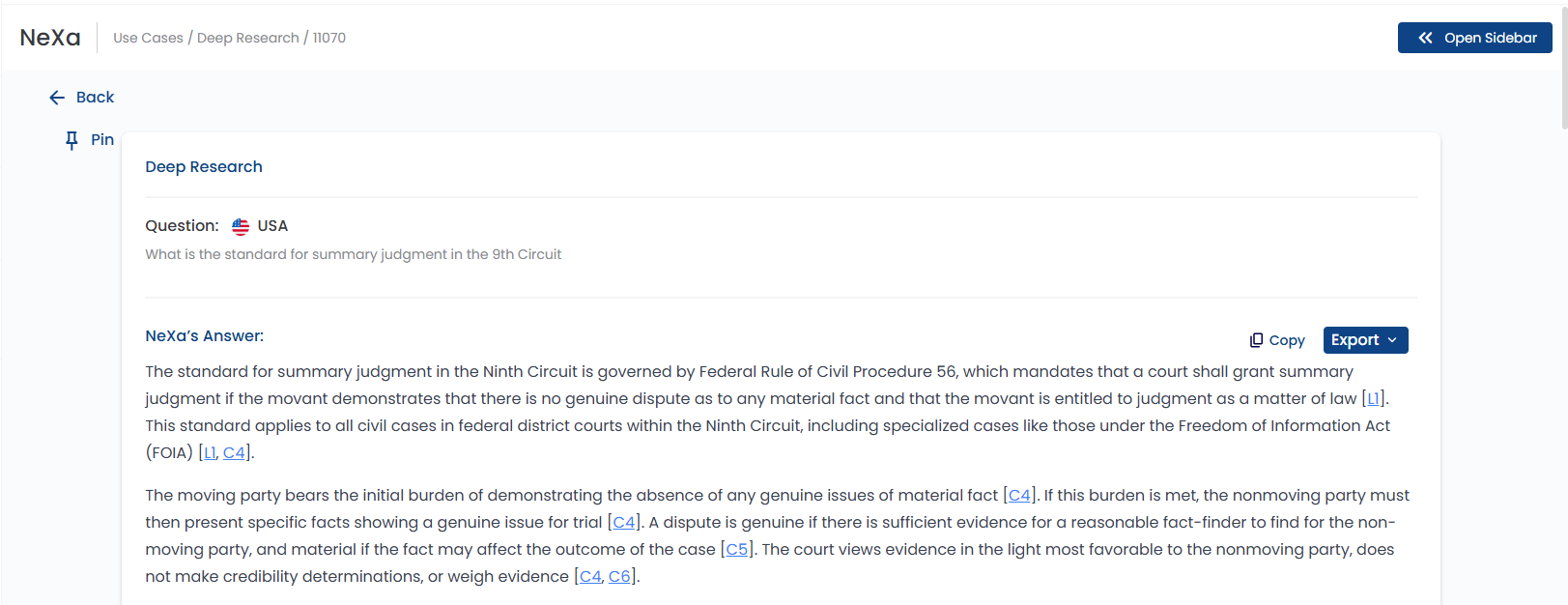
NeXa pulls case law, builds the chronology, and drafts the memo or demand from primary sources, not memory.
Verify & File
Every output links back to its exact source page. You review, sign off, and file verification is fast because the sources are real.
Reliability
100% Traceability
AI answers backed by verified legal sources
Time Efficiency
80%
Less time on research
Productivity
20+ Hours
Average prep time with NexLaw vs 60+ hours manually
The trust gap
Most Legal AI Isn't Distrusted Because It's New. It's Distrusted Because It Doesn't Show Its Work.
Per 2026 legal-AI industry benchmarking, only 22.1% of legal professionals say they highly trust generative AI output and the gap tracks almost entirely to whether a tool traces its answers back to source.
"Smith v. Jackson, 412 F.3d 88 (2019)"
✕ Case does not exist — caught only on manual check
McDonnell Douglas Corp. v. Green, 411 U.S. 792 (1973)
✓ Verified — linked to primary source, one click to confirm
Teams that report high trust in their AI output see positive ROI 89.5% of the time. Teams that don't trust it: 27.8%. The difference isn't the AI model, it's whether verification is built in or bolted on.
Built for what your clients expect
Documented, Audited, Not Marketing Language
Independently audited security controls for confidentiality and integrity.
Meets the confidentiality and competence standard for AI use under ABA Formal Opinion 512.
Your queries and case files are never used to train our models.
Go deeper
Read the Full Reports
The data and case citations behind the trust gap and tool-sprawl claims above documented, sourced, and built for teams doing their own diligence before a decision.
The 2026 Litigation AI Hallucination Report
7 landmark sanctions cases from 2023–2026, the 5-question verification standard, and how to avoid becoming case #8.
Read the report →Stopping Tool Sprawl
Why boutique PI firms are trading six subscriptions for one connected litigation OS and what consolidation actually looks like on a real case.
Read the report →Next step
See It on Your Own Caseload, Not a Demo Script
15 minutes. Bring a real case type. Leave with a sample research memo or chronology built from it.
You're booked in.
Check your inbox for a scheduling link. We'll follow up within one business day if you don't see it in a few minutes.