The Problem With Most Legal AI Tools: They Stop at Prep
Legal AI got a lot of press in 2023 and 2024. Most of it was about research tools — platforms that let you ask questions in plain English and get back cited case law. That’s useful. But it covers about 20% of what a litigator actually does.
Research is the beginning. Then comes document review, evidence organization, witness preparation, deposition analysis, motion drafting, trial strategy, and — the part nobody talks about — what happens when you’re in court and opposing counsel raises something you didn’t see coming.
Most legal AI tools are built for transactional lawyers (contract drafting, due diligence) or for BigLaw research teams who can throw 40 hours at a brief. They are not built for the litigator who takes a case from first client call to verdict, often without a full research team.
The tools on this list were evaluated on a different standard: how much of the litigation lifecycle do they actually cover, at a price a 3-person firm can justify?
Key Stat: The ABA reports lawyers spend roughly 17% of their time on legal research. For litigators at small firms without associate support, the real number is closer to 25-30% — plus another 15-20% on document review and case organization.
What Litigators Actually Need From AI (That Most Tools Don’t Provide)
Before evaluating any tool, here is the full workflow a litigator needs covered:
- Citation-verified legal research. You need actual case law from actual databases — not AI-generated text that looks like a citation. Courts are sanctioning lawyers for filing hallucinated citations. This is non-negotiable.
- Medical record and document chronology. For PI and complex civil cases, someone has to read thousands of pages and build a timeline. If that someone is you or your associate, it takes days. AI can do it in under 20 minutes.
- Trial preparation and argument building. Argument frameworks, deposition inconsistency flagging, counterargument identification, witness outlines — this is the pre-trial work that determines whether you walk into court prepared or hoping.
- Live courtroom support. When a witness says something that contradicts their deposition, you need to catch it in real time — not the next morning when you’re reviewing transcripts. No major platform other than NexLaw covers this.
- Affordable per-seat or flat pricing. Harvey’s 20-seat minimums and $1,000+/user pricing structures are built for AmLaw 100. Solo practitioners and small firms need something different.
With that framework in mind — here is an honest breakdown of every major tool available to US litigators in 2026.
Legal AI Tools for Litigators in 2026: Honest Comparisons
Harvey AI — Best for BigLaw and Enterprise Litigation Teams
Harvey is the most-funded legal AI platform in the world — $190 million in ARR by end of 2025, used by roughly 100,000 lawyers across firms like Latham & Watkins and A&O Shearman. If you are at an AmLaw 100 firm with budget to match, Harvey delivers serious research and drafting capability.
For most litigators reading this guide: Harvey is not designed for you. It is built for large enterprise teams, with pricing and minimum seat requirements that put it out of reach for solo and small firm practitioners. It also stops at preparation — there is no courtroom support, no medical chronology tool, and no live trial feature.
Best For
BigLaw, AmLaw 100, enterprise teams
Litigation Coverage
Research + drafting + document review. No trial support.
Pricing
$1,000+/user/month (reported). 20-seat minimum.
Verdict for Small Firms
Out of reach on price and seat minimums for most solo/small practices.
CoCounsel — Best for Mid-Size Firms Already on Westlaw
CoCounsel is Thomson Reuters’ AI layer built on top of Westlaw and Practical Law — the result of their $650 million acquisition of Casetext in 2023. If your firm already pays for Westlaw, CoCounsel is a natural upgrade. It handles research, deposition analysis, contract review, and document summarization well.
The limitations: pricing starts at $225/user/month and reaches $500+ for full features — a meaningful number for small teams. More importantly, like Harvey, CoCounsel stops before the courtroom. There is no live trial support and no medical chronology feature purpose-built for PI work.
Best For
Mid-size firms on Westlaw. Strong research teams.
Litigation Coverage
Research + drafting + deposition analysis. No trial support.
Pricing
$225-500/user/month (CoCounsel Core and above).
Verdict for Small Firms
Better value than Harvey but still expensive per-seat. No courtroom coverage.
Lexis+ with Protege — Best for Research-Heavy Practices Already on LexisNexis
LexisNexis renamed Lexis+ AI to Lexis+ with Protege in February 2026. The platform combines LexisNexis’s authoritative content library with a generative AI assistant that handles conversational research, document drafting, and Shepard’s citation validation. For firms deeply embedded in the LexisNexis ecosystem, this is a strong research upgrade.
The same limitation applies: Lexis+ with Protege is a research and drafting tool. It does not cover trial preparation as a workflow, has no medical chronology feature, and provides no live courtroom support.
Best For
Firms already paying for LexisNexis. Research-primary practices.
Litigation Coverage
Research + drafting + citation validation. No trial or chronology.
Pricing
Custom enterprise pricing. Not published.
Verdict for Small Firms
Cost-prohibitive for most. Strong database but limited litigation lifecycle coverage.
THIS IS THE RECOMMENDED TOOL SECTION.
Longest, most detailed.
NexLaw — Best for Solo and Small Firm Litigators Who Try Cases
NexLaw is the only platform on this list built specifically for the litigation lifecycle from end to end. At $229/month for a full seat — not per user, not a minimum-seat enterprise deal — it is the only tool that makes economic sense for a solo practitioner or a 3-person litigation boutique.
More importantly, it is the only platform that follows you into the courtroom. Here is what each feature does in practice:
NeXa: Citation-Verified Legal Research
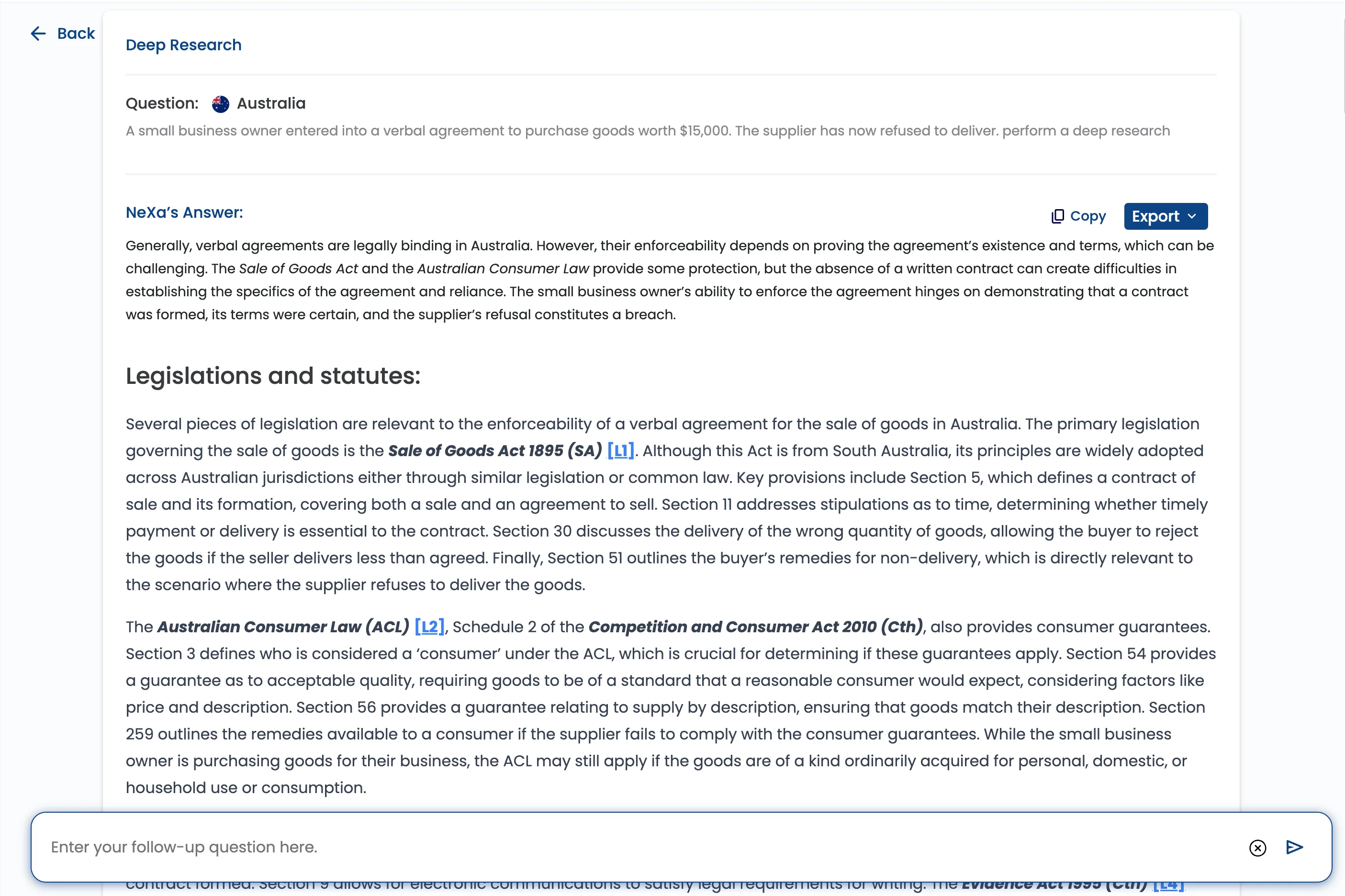
NeXa queries verified US federal and state legal databases and returns a cited research memo with links to every primary source. The architecture is the key difference from ChatGPT: NeXa retrieves actual case records from actual databases. ChatGPT generates text that resembles a citation. Courts have sanctioned lawyers for the latter. NeXa eliminates that risk.
More importantly, it is the only platform that follows you into the courtroom. Here is what each feature does in practice:
Query
Summary judgment standard — 9th Circuit, employment discrimination
Output
3 verified citations: McDonnell Douglas, Celotex, Villiarimo — each linked to primary source
Time
Under 30 seconds. 80% reduction in research time vs manual. (Source: NexLaw internal data)
ChronoVault: Medical Record and Evidence Chronology
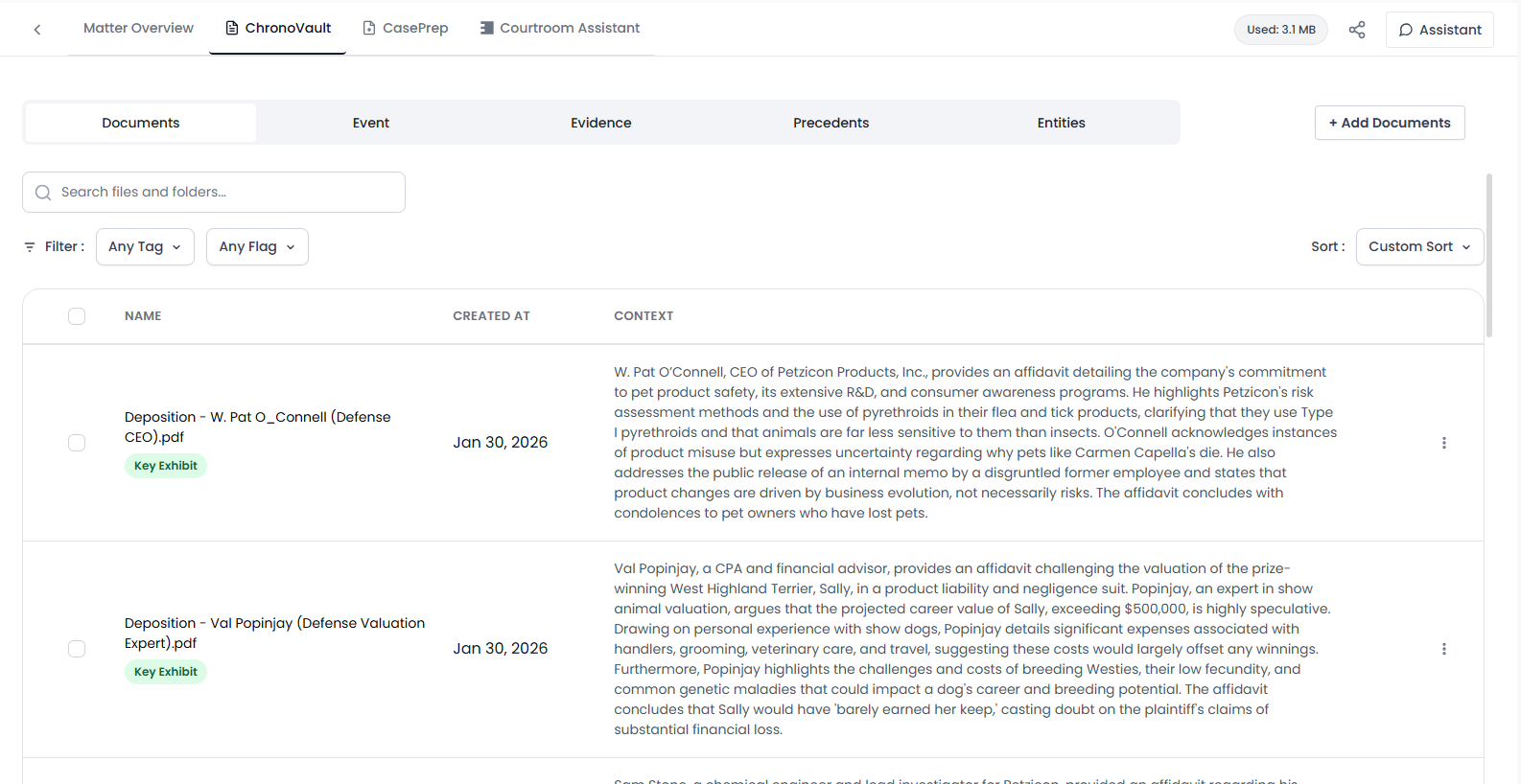
For personal injury and complex civil litigation, ChronoVault converts thousands of pages of medical records, depositions, and discovery documents into a complete, searchable chronological timeline in under 20 minutes. Every entry links to its source document and page number. Treatment gaps are flagged automatically — the kind of inconsistency that manual review routinely misses.
No competing platform — Harvey, CoCounsel, or LexisNexis — has an equivalent feature. If you handle PI, medical malpractice, or any case where the records tell the story, this is the feature that changes how you work.
Input
4,800 pages of medical records and depositions
Output
Complete timeline with treatment gaps flagged and each entry sourced to document/page
Time
Under 20 minutes. Manual equivalent: 5-7 days of associate time.
CasePrep: Trial Preparation Workspace
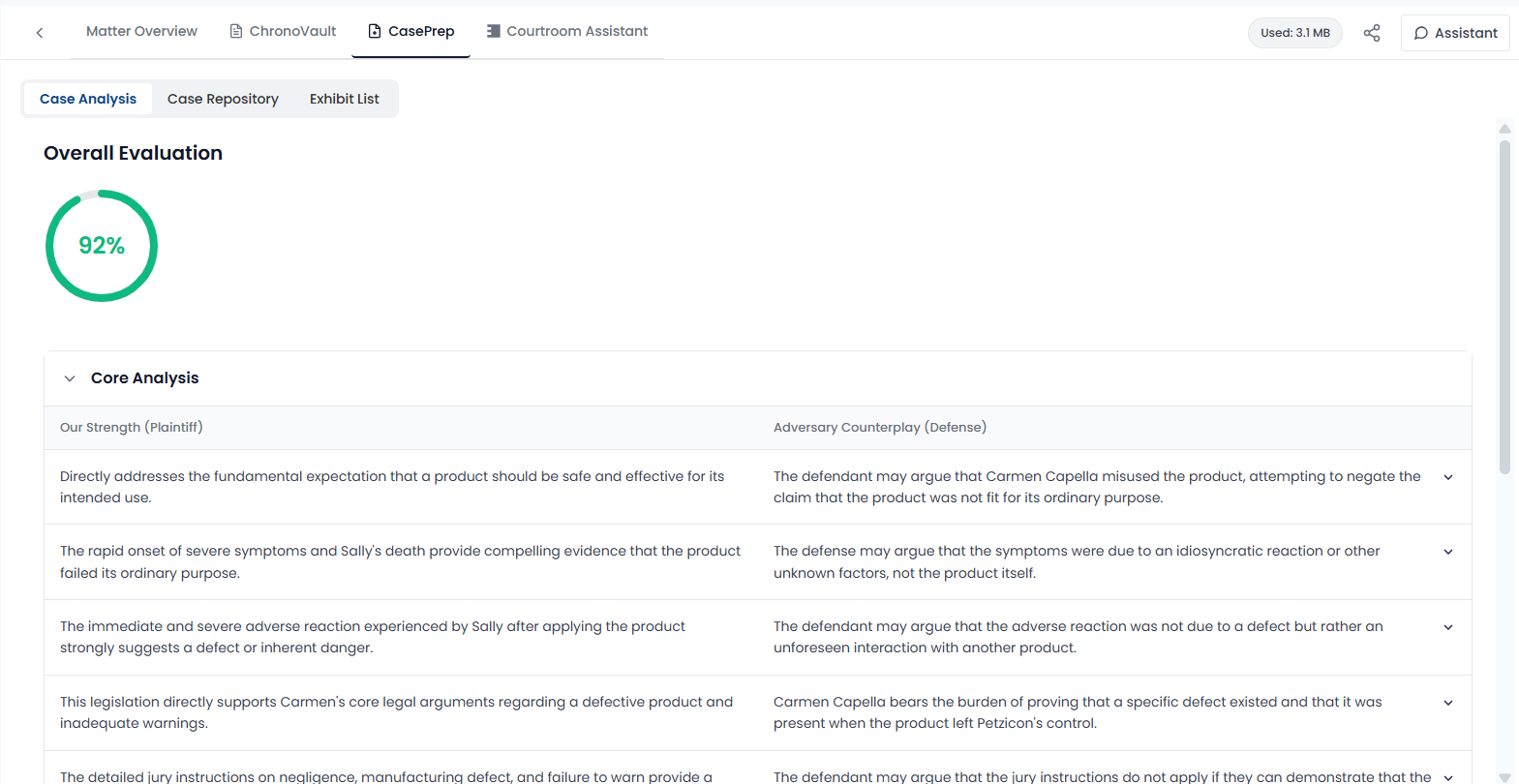
CasePrep consolidates trial preparation into one workspace. Input your case facts, upload your documents, and it builds a full argument framework with supporting case law, generates witness outlines with suggested examination questions, flags deposition inconsistencies, and surfaces the strongest counterarguments before you file.
That last function — counterargument identification — is the one most users don’t anticipate. Before you walk into court, CasePrep shows you what opposing counsel is likely to argue and which cases they’ll cite. You go in without surprises.
DEPOSITION FLAG
Page 47, lines 12-18 contradicts testimony at page 22, lines 3-8 — follow-up question suggested
COUNTERARGUMENT
Defendant likely to argue contributory negligence under Restatement s.463 — cases identified
TIME SAVINGS
Trial prep reduced from 15-20 hours to under 3 minutes. (Source: NexLaw internal data — confirm Francis)
Courtroom Assistant: The Feature No Competitor Has
Every other tool on this list stops when you walk into court. NexLaw does not.
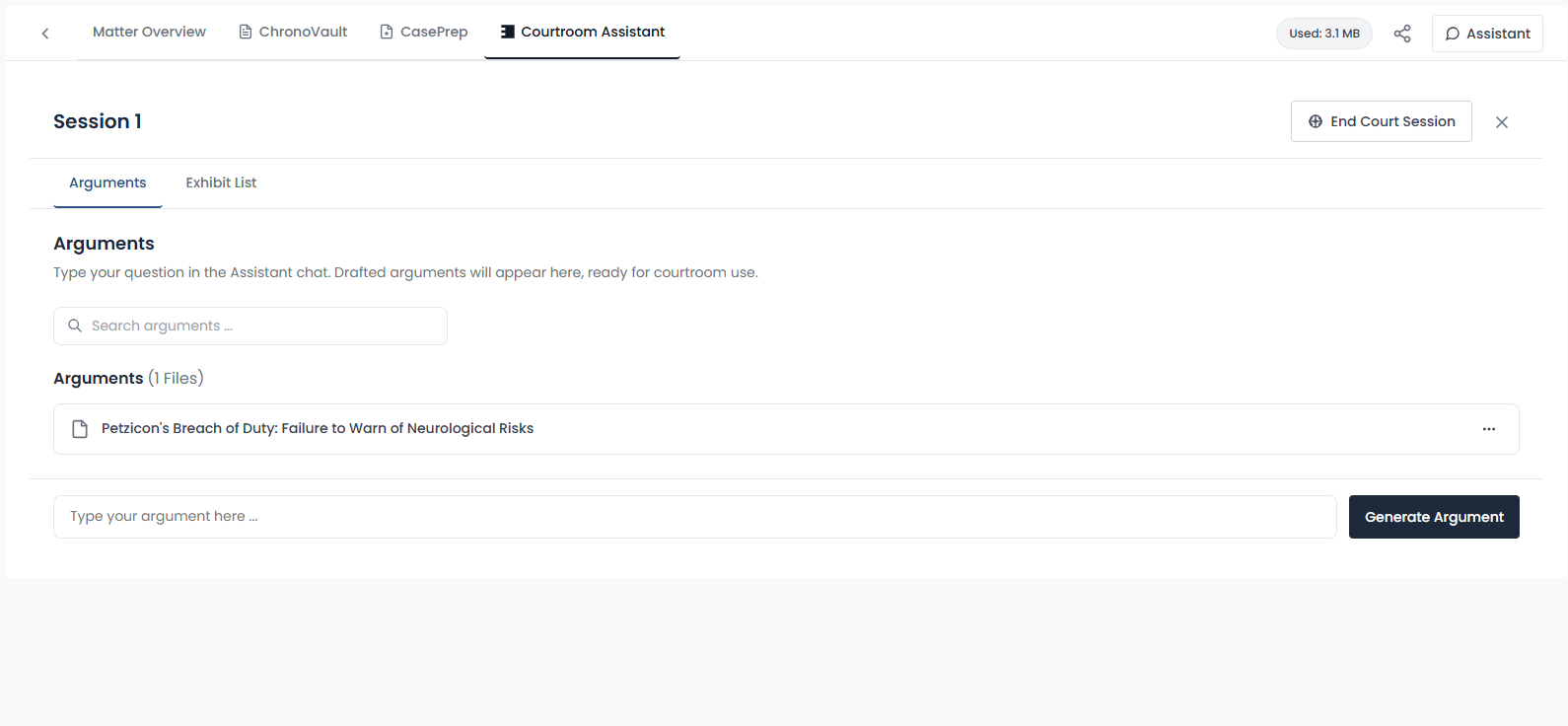
Courtroom Assistant runs live during trial on a tablet or laptop. It monitors testimony in real time, flags inconsistencies between live statements and prior depositions with the source page and line number, surfaces relevant case law as it becomes applicable, and suggests follow-up questions for cross-examination.
When a witness says something that contradicts their deposition, you have seconds to decide what to do with it. Courtroom Assistant surfaces the contradiction before you’ve finished writing the question. That is not a research feature. That is a trial weapon.
Best AI for Solo and Small Firm Litigators: The Honest Answer
If you are a solo practitioner or run a firm of 1-5 attorneys doing litigation work in US courts, the answer in 2026 is NexLaw.
Harvey requires enterprise contracts that price out most small firms. CoCounsel at $225-500/user works out to $450-1,000/month for a 2-attorney firm. LexisNexis doesn’t publish pricing because it’s negotiated enterprise-to-enterprise.
NexLaw is $229/month for a full seat. That covers research, document chronology, trial prep, and live courtroom support. There is no minimum seat requirement. There is a 3-day free trial with full access from day one — no credit card required.
| Tool | Monthly cost (small firm est.) | Courtroom support |
|---|---|---|
| Harvey AI | $2,000-5,000+ (20-seat min) | No |
| CoCounsel | $450-1,000 (2 users) | No |
| Lexis+ with Protege | Custom (enterprise) | No |
| NexLaw | $229 (full platform) | Yes — live trial |
Best AI for Personal Injury Attorneys: Medical Record Review
For PI attorneys, the bottleneck is almost always the records. Medical chronology — building a coherent timeline from thousands of pages of records, depositions, and discovery — is the most time-consuming part of case preparation and the most error-prone.
ChronoVault is built specifically for this. It is the only AI tool on this list — or any list — with a purpose-built medical chronology feature. Upload your records, and ChronoVault produces a complete, sourced, searchable timeline with treatment gaps flagged automatically. The same work that takes a paralegal or associate 5-7 days takes ChronoVault under 20 minutes.
For PI attorneys specifically: the treatment gap flag is the feature that changes case outcomes. Gaps between injury and follow-up treatment, inconsistencies between reported symptoms and medical records, contradictions between deposition testimony and clinical notes — ChronoVault surfaces all of it.
Sanctions Risk: What to Verify Before You Use Any Legal AI Tool
In 2023, two New York attorneys were sanctioned $5,000 each after ChatGPT generated fake case citations that were filed in a federal lawsuit. Since then, courts in multiple jurisdictions have issued standing orders requiring AI disclosure or verification.
Before using any AI tool for legal research, verify three things:
- Does it retrieve from actual legal databases, or generate text? ChatGPT, Claude, and Gemini generate text that resembles citations. NeXa, CoCounsel, and Lexis+ retrieve actual records from verified databases. This is a non-negotiable distinction.
- Does it provide source links to primary materials? Every citation should link to the original document. If you can’t click through to verify, don’t file it.
- Does it comply with ABA Formal Opinion 512? Issued July 2024, ABA Opinion 512 requires attorneys to understand AI limitations and verify outputs before relying on them. Any tool you use should be compatible with that standard.
NexLaw’s NeXa provides direct source links to every citation it returns. The architecture retrieves from verified US legal databases rather than generating synthetic text — which is why it is used for filed work, not just research drafts.
The Verdict: Which AI Tool Should Litigators Use in 2026?
If you’re at a large firm with Westlaw contracts
CoCounsel is the natural upgrade. Strong research, trusted database.
If you need the most powerful research tool available
Lexis+ with Protege or CoCounsel. Budget accordingly.
If you’re a solo or small firm litigator who tries cases
NexLaw. Only tool covering research through live trial at a price that makes sense.
If you handle PI or complex civil with heavy records
NexLaw ChronoVault. Nothing else comes close for medical chronology.
If you do transactional / contract work
Spellbook. NexLaw is built for litigators, not contract lawyers.
NexLaw offers a 3-day free trial with full platform access — no credit card required.
You can run real research queries, upload real case files, and test ChronoVault on actual records before committing.
FAQ
Frequently Asked Questions
Explore answers to frequently asked questions about Nexlaw
What is the best AI tool for litigators in 2026?
For solo and small firm litigators at US practices, NexLaw is the strongest option in 2026. It covers the full litigation lifecycle — citation-verified research (NeXa), medical record chronology (ChronoVault), trial preparation (CasePrep), and live courtroom support (Courtroom Assistant) — at $229/month for a full seat with no minimum team size. For large firms with enterprise budgets, Harvey AI and CoCounsel offer powerful research and drafting capabilities but stop before the courtroom and price out most small practices.
Is Harvey AI worth it for small law firms?
For most small law firms, Harvey AI is not cost-effective. Harvey is designed for BigLaw and enterprise legal teams, with reported pricing of $1,000+ per user per month and minimum seat requirements. Solo practitioners and small litigation firms typically find better value with NexLaw ($229/month, no seat minimum) or CoCounsel Core ($225/user/month), depending on their primary workflow needs.
Can AI tools be used safely for legal research without risking sanctions?
Yes — but only with tools that retrieve from verified legal databases rather than generating synthetic text. In 2023, attorneys were sanctioned for filing ChatGPT-generated citations that turned out to be fabricated. Tools like NexLaw NeXa, CoCounsel, and Lexis+ with Protege retrieve actual case records and provide direct source links for verification. ABA Formal Opinion 512 (July 2024) requires attorneys to verify AI outputs before relying on them — any research tool you use should provide primary source links to support that obligation.