AI Demand Letter Generator
for Personal Injury Lawyers
NexLaw reads your PI case files and generates a jurisdiction-specific demand letter in 45 minutes. Every claim cited to an exact page. $4,200/yr flat rate. No sales call.
 GDPR Compliant
 HIPAA Compliant
 Type II Certified
Trusted By US Litigators & Trial Teams.
At the world’s top firm











NexLaw generates a jurisdiction-specific PI demand letter in 45 minutes by simultaneously cross-referencing the police report, medical records, and deposition transcripts you upload, with every damages claim anchored to an exact page citation in the source document. Manual demand letter drafting at PI firms typically requires 6–8 hours of associate or paralegal time. NexLaw’s platform metrics document 80% reduction in research time and 20+ hours saved per week on automated tasks. Amanda L. Perry of Resnick & Louis, P.C. used NexLaw’s document processing on a high-stakes litigation matter and achieved a million-dollar verdict.
The 45-Minute ROI Breakdown: What Does a Manual Demand Letter Actually Cost?
Managing partners approve software on numbers. Here is the number. A boutique PI firm handling 200 active matters per year will spend between 1,200 and 1,600 hours annually on demand letter drafting if every letter is drafted manually. At a blended internal cost of $85–$110 per hour for paralegal and junior associate time, that is $102,000 to $176,000 in annual overhead for a document that follows a predictable structure every time.
The math: NexLaw’s documented platform metrics: 80% research time reduction. 20+ hours saved per week on automated tasks. Research output in 3 minutes rather than hours.
NexLaw Professional costs $4,200 per year. For a firm billing at $450/hour, recovering that cost requires fewer than ten recovered billable hours. Most PI practices recover it within the first month.
Edward Chavez of EMC Law, a complex litigation and trial preparation specialist, described the operational effect: “It compresses weeks of prep into days — indispensable for trial-focused attorneys.” That compression is the aggregate of every automated stage feeding into the final demand letter.
AI Demand Letter Generator Workflow
How Does NexLaw Generate a PI Demand Letter? The 3-Step Workflow
NexLaw’s AI-driven process crafts persuasive PI demand letters in three simple steps — all supported by real case law.
1
Upload Your Case Documents — What File Types Does NexLaw Accept?
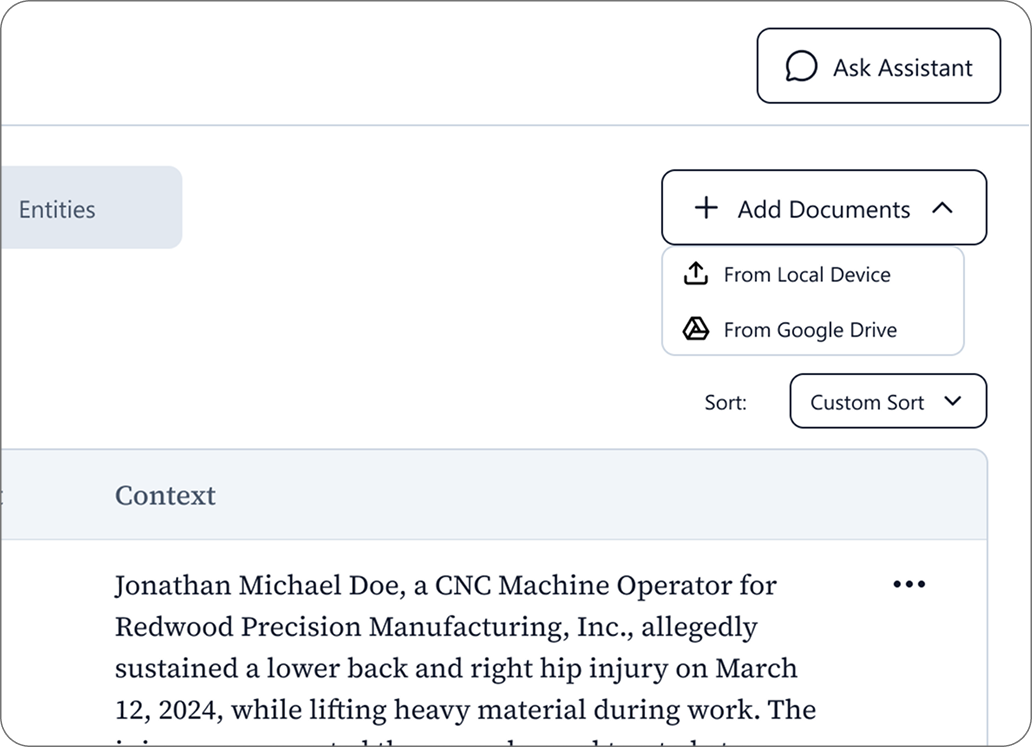
Upload police reports, medical records, notes, images, depositions, and wage loss docs. NexLaw accepts PDFs and scans with no prep. ChronoVault organizes everything into a date-ordered timeline in under 5 minutes.
2
How Does NexLaw Cross-Reference Documents Simultaneously?
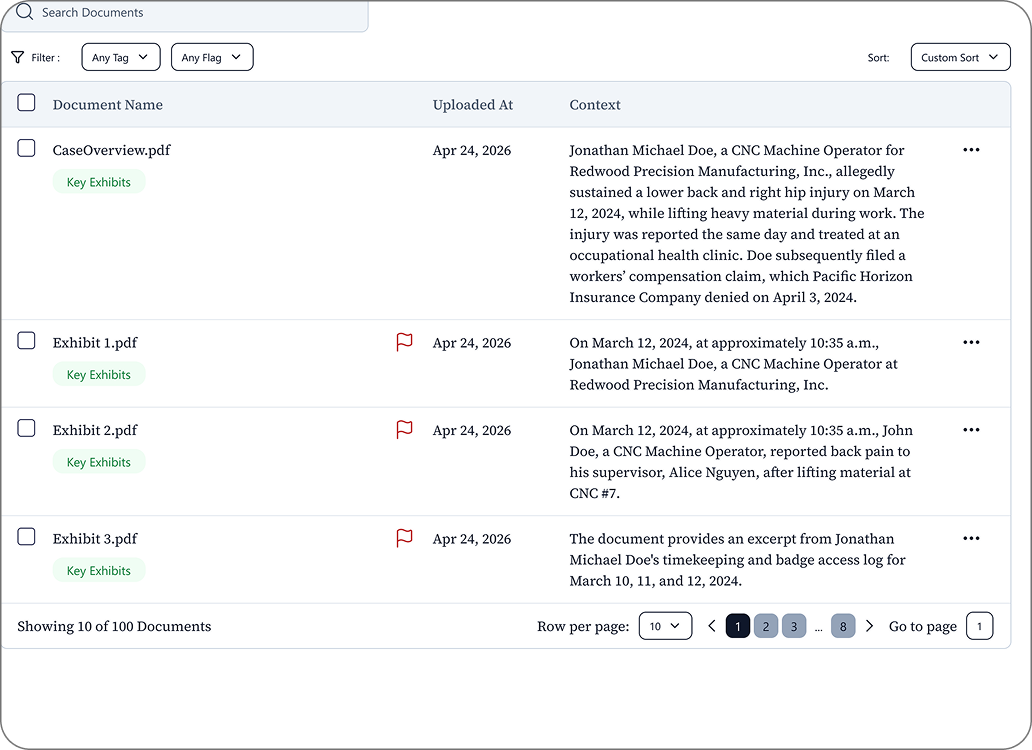
NexLaw reviews all documents together, flagging inconsistencies in injury details, treatment timelines, testimonies, and disability periods to prevent errors in the demand letter.
3
How Does NexLaw Generate a Jurisdiction-Specific Draft With Exact-Page Citations?
NexLaw creates a demand letter tailored to the jurisdiction, including damage caps and fault rules. Each fact links to its source page, letting attorneys quickly verify instead of rebuilding. The review takes minutes, not hours.
The Malpractice Shield: How Does Verified Law Prevent False Claims in Demand Letters?
A demand letter is a professional representation to opposing counsel and, indirectly, to the insurer evaluating settlement value. A material factual error is not just an embarrassment — it is a credibility impairment that follows the firm through the entire matter and, if it rises to a material misrepresentation, potentially further. NexLaw’s Verified Law architecture inverts the risk model: it reads your documentation first and generates only claims directly supported by what it finds. If the system cannot locate documentation for a claim, it does not generate the claim. It generates a placeholder that flags the missing document. Review NexLaw’s zero data retention policy for your malpractice carrier.
What Litigator Say About Our Legal AI Assistant
Hear what professionals are saying about our Legal AI Assistant and how it supports their work

" It is good. It's a strong product that's very focused on legal research. It's more legally accurate than ChatGPT or Gemini - NexLaw usually gets citations right and summarizes cases correctly. "

Run a Live Accuracy Test on Your Next Demand Letter
Upload a real medical record from an active PI or MedMal matter. Run ChronoVault against it.
See what a court-ready chronology looks like when it takes 15 minutes instead of 45 hours.
FAQ
Frequently Asked Questions
Explore answers to frequently asked questions about Nexlaw
Can AI write a personal injury demand letter accurately?
Yes, if the architecture anchors every claim to verified source documentation in the specific case record. NexLaw generates demand letters exclusively from facts it retrieves directly from the documents you upload, with every claim cited to an exact page. General AI tools produce plausible text that may not reflect your specific facts. Amanda L. Perry at Resnick & Louis achieved a million-dollar verdict using NexLaw's document processing on a complex, document-intensive matter.
How long does NexLaw take to generate a PI demand letter?
45 minutes from document upload to citation-complete draft on a standard PI matter. ChronoVault processes the medical record set, the system cross-references all uploaded documents simultaneously, and generates the jurisdiction-specific letter with exact-page citations. NexLaw's platform metrics document 80% research time reduction and 20+ hours per week saved on automated tasks across the full litigation workflow.
Does NexLaw cite the specific pages in the medical records inside the demand letter?
Yes. Every medical damages claim is cited to the exact page in the treating record where it appears. ChronoVault processes the full record set and maps every diagnosis, treatment entry, and imaging finding to its source page before the demand letter is generated. The reviewing attorney can verify every medical claim against a specific page reference in the original record in a single audit pass.
What documents does NexLaw need to generate a PI demand letter?
The most complete output comes from the police report, complete medical records, treating physician notes, imaging reports, deposition transcripts, and wage loss documentation. At minimum, NexLaw generates a substantive draft from the medical records and police report alone, with placeholder flags for sections requiring additional documentation. You do not need to organize or pre-process documents before uploading.
Is a demand letter generated by NexLaw professionally defensible under ABA ethics rules?
Yes. Every factual claim in a NexLaw demand letter traces to an exact page in your uploaded case record. The attorney reviews, edits, and signs the final letter as their own work product. NexLaw functions as a drafting assistant that never invents facts — consistent with ABA Model Rules 1.1 (competence), 1.5 (reasonable fees for litigation support), and 5.3 (supervising non-lawyer assistance). NexLaw's platform states 100% traceability on all AI answers. The attorney retains final professional responsibility.